
Zumbido urbano: implicação dos polinizadores silvestres na carga poliníca de 'Solanum lycopersicum' em Rosario
Barra lateral de artigos
Conteúdo do artigo principal
Resumo
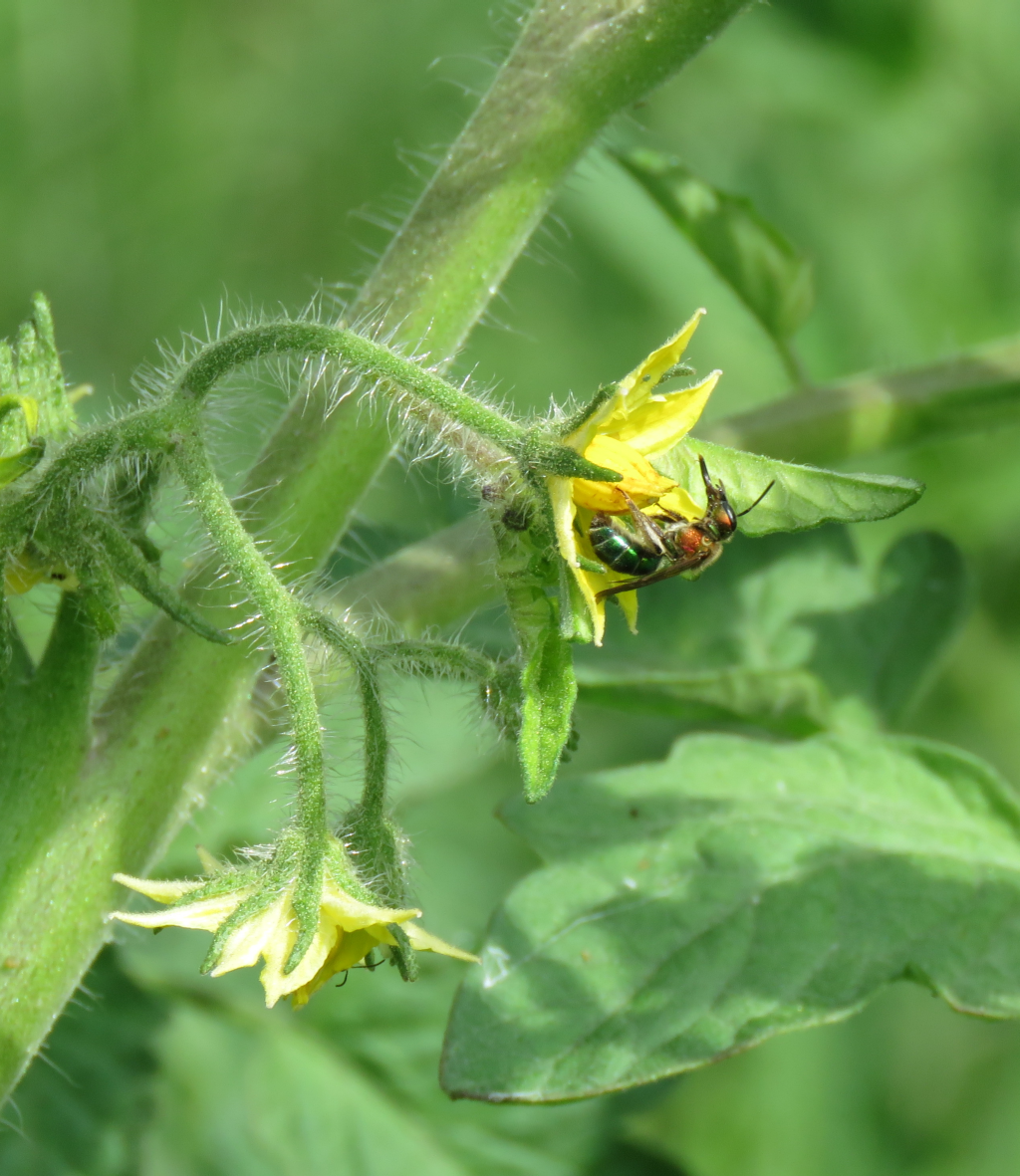
A fauna de polinizadores silvestres em hortas periurbanas de Rosario (Santa Fe, Argentina) permanece praticamente desconhecida, apesar de diversas culturas, como Solanum lycopersicum var. platense (tomate), melhorarem sua produção com esses insetos. Embora o tomate possa produzir frutos por autopolinização, a polinização mediada por insetos aumenta significativamente a produção de frutos. Este estudo teve dois objetivos principais: (i) elaborar um inventário de polinizadores silvestres em hortas periurbanas de tomate e (ii) quantificar o depósito de pólen nos estigmas causada pelas visitas de insetos. Foram realizadas observações em 60 inflorescências de tomate em quatro hortas, registrando a abundância, frequência e comportamento dos visitantes florais. Foi comparada a quantidade de pólen depositado nos estigmas das flores expostas aos visitantes com a quantidade de pólen depositado nos estigmas das flores excluídas dos visitantes (n=96). Nove morfoespécies foram identificadas, cinco das quais corresponderam a abelhas capazes de realizar polinização por zumbido (buzz‑pollination), destacando-se a família Halictidae pela sua abundância (107 visitas). As abelhas que coletam pólen por zumbido representaram a maioria das visitas. Os estigmas expostos apresentaram mais do que o dobro de grãos de pólen em comparação com os estigmas das flores excluídas. As hortas periurbanas podem funcionar como locais de alimentação para polinizadores nativos, contribuindo para o aumento do processo de polinização.
Downloads
Detalhes do artigo

Este trabalho está licenciado sob uma licença Creative Commons Attribution-NonCommercial-ShareAlike 4.0 International License.
Os autores mantêm os direitos autorais e concedem à revista o direito de primeira publicação do trabalho sob uma licença Creative Commons (BY-NC-ND) que permite que outros compartilhem com reconhecimento de autoria e publicação inicial nesta revista. Os autores estão autorizados a celebrar contratos adicionais separados para a distribuição não exclusiva da versão do trabalho publicado nesta revista. Autores estão autorizados a divulgar seus trabalhos eletronicamente.
Referências
AIZEN, M. A., HARDER, L. D. (2007) Expanding the limits of the pollen-limitation concept: effects of pollen quantity and quality. Ecology, 88(2), 271–281.
ALDANA, J., CURE, J.R., ALMANZA, M.T., VECIL, D., RODRÍGUEZ, D. (2007) Effect of Bombus atratus (Hymenoptera: Apidae) on tomato production (Lycopersicon esculentum Mill.) in greenhouse in Bogotá plateau, Colombia. Agronomía Colombiana, 25: 62–71.
ALVAREZ, L.J., LUCIA, M., RAMELLO, P.J., DEL PINO, M., ABRAHAMOVICH, A.H. (2014) Abejas asociadas a cultivos de berenjena (Solanum melongena L., Solanaceae) en invernadero del Cinturón Hortícola de La Plata, Buenos Aires, Argentina. Revista de la Facultad de Agronomía, La Plata, 113: 211–217.
AMALA, U. (2017) Role of native buzz pollinator bees in enhancing fruit and seed set in tomatoes under open field conditions. Journal of Entomology and Zoology Studies, 5: 1742–1744.
ANDREWS, E.S., THEIS, N., ADLER, L.S. (2007) Pollinator and herbivore attraction to Cucurbita floral volatiles. Journal of Chemical Ecology, 33: 1682–1691.
ARIAS RESTREPO, S.M., TORRES CARRERA, J.D., MOLINA RICO, L.J. (2015) Estructura de la comunidad polinizadora en un cultivo de tomate Lycopersicon esculentum Mill. (Solanaceae) y análisis multivariado de la calidad del fruto, Caldas – Colombia. Scientia et Technica, 20: 382.
BATES, D., MÄCHLER, M., BOLKER, B. & WALKER, S. (2015) Fitting Linear Mixed-Effects Models using lme4. Journal of Statistical Software, 67(1).
BRACALENTI, L., ZIMMERMANN, E., ONOCKO, A., MENDÍAZ, G., MOSCONI, P., VÁZQUEZ, J., CAZZOLI, I., PÉREZ, A., MACIEYKO, C., RITTERBUCH, B., VALIENTE, J., VAZQUEZ, F., TERRILE, R., CENTRO, C. (2019) Paisaje productivo en la ciudad de Rosario. Prestaciones posibles para la adaptación y la mitigación del cambio climático.
BUCHMANN, S.L. (1985) Bees use vibration to aid pollen collection from non-poricidal flowers. Journal of the Kansas Entomological Society, 58: 517–525.
CARRIZO GARCIA, C., MATESEVACH, M., BARBOZA, G. (2008) Features related to anther opening in Solanum species (Solanaceae). Botanical Journal of the Linnean Society, 158 (2): 344-354.
CERNA CHÁVEZ, E., LARA SÁNCHEZ, E.D., OCHOA FUENTES, Y., HERNÁNDEZ BAUTISTA, O., AGUIRRE URIBE, L.A., LANDEROS FLORES, J., FLORES CANALES, R. (2015) Comparación de cuatro especies entomófilas sobre parámetros agronómicos del fruto de tomate de invernadero. Revista Mexicana de Ciencias Agrícolas, 2241.
COOLEY, H., VALLEJO-MARÍN, M. (2021) Buzz-pollinated crops: a global review and meta-analysis of the effects of supplemental bee pollination in tomato. Journal of Economic Entomology, 114: 505–519.
CORTI, C., MEROI ARCERITO, F.R., FERNANDEZ DE LANDA, G., MAZZEI, M.P., FERNANDEZ DE LANDA, M., MAGGI, M., GALETTO, L. (2024) Tomato production under greenhouse conditions: bumblebees or hormones? Scientia Horticulturae, 326: 112747.
DAFNI, A. (1922) Pollination Ecology a practical approach. Toronto: Oxford University Press. 250p.
DELIGNETTE-MULLER, M. L., DUTANG, C. (2015) Fitdistrplus : An R package for fitting distributions. Journal of Statistical Software, 64(4), 1–34.
DEPRA, M.S., DELAQUA, G.G., FREITAS, L., GAGLIANONE, M.C. (2014) Pollination deficit in open-field tomato crops (Solanum lycopersicum L., Solanaceae) in Rio de Janeiro state, Southeast Brazil. Journal of Pollination Ecology, 12.
FERNÁNDEZ, P. C.; FARINA, W. M. (2001) Changes in food source profitability affect Nasonov gland exposure in honeybee foragers Apis mellifera L. Insectes Sociaux, 48(4), 366–371
GABRI MARTÍN, C.G., CUESTA, G. (2013) Efecto de distintas técnicas para el establecimiento de frutos en la producción de tomate bajo invernadero. Universidad Nacional de San Juan.
GESLIN, B., MORALES, C. L. (2015) New records reveal rapid geographic expansion of Bombus terrestris Linnaeus, 1758 (Hymenoptera: Apidae), an invasive species in Argentina. Check List, 11, 1620-1620.
GREENLEAF, S.S., KREMEN, C. (2006) Wild bee species increase tomato production and respond differently to surrounding land use in Northern California. Biological Conservation, 133: 81–87.
GRÜTER, C.; ACOSTA, L. E.; FARINA, W. M. (2006) Propagation of olfactory information within the honeybee hive. Behavioral Ecology and Sociobiology, 60(5), 707–715.
HARTIG, F. (2021) DHARMa: Residual Diagnostics for Hierarchical (Multi-Level / Mixed Regression Models).
HERWIG, T. (2005) Pollinators of tomato, Solanum lycopersicum (Solanaceae), in Central Europe. Phyton, 45: 217–235.
HUSBAND, B. C., SCHEMSKE, D. W. (1996) Evolution of the magnitude and timing of inbreeding depression in plants. Evolution, 50(1), 54–70.
JAYASINGHE, U.J.M., R., S., SILVA, T.H., E., S., KARUNARATNE, W.A., P., I. (2017) Buzzing wild bee visits enhance seed set in eggplant, Solanum melongena. Psyche: A Journal of Entomology, 1–7.
KONÉ, K., TUO, Y., YAPO, M.L., TRAORÉ, D., SORO, F., KOUA, K.H. (2019) Diversity, abundance and activity of bees in zucchini (Cucurbita pepo L.) crops in northern Côte d’Ivoire. International Journal of Entomology Research, 4: 41–45.
DE LUCA, P.A., VALLEJO-MARÍN, M. (2013) What’s the ‘buzz’ about? The ecology and evolutionary significance of buzz-pollination. Current Opinion in Plant Biology, 16: 429–435.
FONTÚRBEL, F. E., MURÚA, M. M., VIELI, L. (2021) Invasion dynamics of the European bumblebee Bombus terrestris in the southern part of South America. Scientific Reports, 11(1), 15306.
LEE, T. D. (1988) Patterns of fruit and seed production. In J. LOVETT DOUST, L. LOVETT DOUST (Eds.), Plant reproductive ecology: Patterns and strategies (pp. 179–194). Oxford University Press.
LÜDECKE, D. (2018) ggeffects: Tidy Data Frames of Marginal Effects from Regression Models. Journal of Open Source Software, 3(26), 772.
MALERBO-SOUZA, D.T., ANDRADE, M.O., MEDEIROS, N.M.G., SILVA, T.G., SIQUEIRA, R.A. (2019) Biodiversidade e comportamento forrageiro de abelhas na cultura da aboboreira italiana (Cucurbita pepo). Colloquium Agrariae, 15: 11–21.
MARTINEZ, S., GARBI, M., CARBONE, A., MORELLI, G., ARGERICH, C., PACHECO, R., PUCH, L. (2016) Aplicación de reguladores auxínicos: efecto sobre el cuajado de fruto en tomate para consumo fresco. Asociación Argentina de Horticultura, 35: 30–40.
MAZZEI, M.P., GALETTO, L., VESPRINI, J.L. (2025) The role of native and exotic bees in Cucurbita maxima var. zapallito pollination: the effects of pollination intensity and visits on commercial fruits. Apidologie, 56(1): 17.
MAZZEI, M.P., VESPRINI, J.L., BREEZE, T.D., IGLESIAS, M.D.R., GALETTO, L. (2024) Creating territorialized sustainability indices to evaluate pollination. Agricultural Systems, 219.
MAZZEI, M. P., VESPRINI, J. L., GALETTO, L. (2021) Seminatural habitats and their proximity to the crop enhances canola (Brassica napus) pollination and reproductive parameters in Argentina. Crop Science, 61(4), 2713–2721.
DE MELO, C., NETO, S., LIMA GOMES, F., GONÇALVES, B.B., BERGAMINI LIMA, L., DA SILVA E ELIAS, M.A., FRANCESCHINELLI, E.V. (2013) Native bees pollinate tomato flowers and increase fruit production. Journal of Pollination Ecology, 11: 41–45.
MONDINO, M.C., GRASSO, R., BALABAN, D., ORTIZ MACKINSON, M. (2021) Censo 2021 del cinturón hortícola de Rosario.
MORANDIN, L.A., LAVERTY, T.M., KEVAN, P.G. (2001) Effect of bumble bee (Hymenoptera: Apidae) pollination intensity on the quality of greenhouse tomatoes. Journal of Economic Entomology, 94: 172–179.
MUNICIPALIDAD DE ROSARIO (2020) Proyecto Cinturón Verde: informe anual de gestión y acción.
MUNICIPALIDAD DE ROSARIO (2022) Agricultura urbana Rosario. https://www.agriurbanarosario.com.ar/espacios-de-agricultura-urbana.php
PATRICIO, G.B., GRISOLIA, B.B., DESUOACUTE, I.C., MONTAGNANA, P.C., BROCANELLI, F.G., GOMIG, E.G., DE CAMPOS, M.J.O. (2012) The importance of bees for eggplant cultivations (Hymenoptera: Apidae, Andrenidae, Halictidae). Sociobiology, 59: 1037–1052.
R CORE TEAM (2024) R: a language and environment for statistical computing.
RAW, A. (2000) Foraging behaviour of wild bees at hot pepper flowers (Capsicum annuum) and its possible influence on cross pollination. Annals of Botany, 85: 487–492.
RIAT, P., LAMBARÉ, D.A., STAMPELLA, P.C., POCHETTINO, M.L. (2015) La diversificación del paisaje como aspecto clave de la sustentabilidad social de los sistemas agroecológicos campesinos. En: Memorias del V Congreso Latinoamericano de Agroecología, pp. 1–6.
ROSI-DENADAI, C.A., ARAÚJO, P.C.S., CAMPOS, L.A. DE O., COSME, L., GUEDES, R.N.C. (2020) Buzz pollination in Neotropical bees: genus dependent frequencies and lack of optimal frequency for pollen release. Insect Science, 27: 133–142.
ROULSTON, T. H.,GOODELL, K. (2011) The Role of Resources and Risks in Regulating Wild Bee Populations. Annual Review of Entomology, 56(1), 293–312.
SÁEZ, A., SABATINO, M., AIZEN, M.A. (2012) Interactive effects of large- and small-scale sources of feral honey-bees for sunflower in the Argentine Pampas. PLoS ONE, 7: e30968.
SANTONE, A., MAZZEI, M. P., VESPRINI, J., TORRES, C., AMARILLA, L. D., GALETTO, L. (2022) Pollination service and soybean yields. Acta Oecologica, 116, 103846
SARANDÓN, S.J. (2019) Potencialidades, desafíos y limitaciones de la investigación agroecológica como un nuevo paradigma en las ciencias agrarias. Revista FCA UNCUYO, 51: 383–394.
TANKSLEY, S.D. (2004) The genetic, developmental, and molecular bases of fruit size and shape variation in tomato. The Plant Cell, 16: 181–189.
VINÍCIUS-SILVA, R., PARMA, D. DE F., TOSTES, R.B., ARRUDA, V.M., WERNECK, M. DO V. (2017) Importance of bees in pollination of Solanum lycopersicum L. (Solanaceae) in open-field of the Southeast of Minas Gerais State, Brazil. Hoehnea, 44: 349–360.
WICKHAM, H. (2016) ggplot2: Elegant Graphics for Data Analysis. Springer, Verlag New York.
WONGSA, K., DUANGPHAKDEE, O., RATTANAWANNEE, A. (2023) Pollination efficacy of stingless bees, Tetragonula pagdeni Schwarz (Apidae: Meliponini), on greenhouse tomatoes (Solanum lycopersicum Linnaeus). PeerJ, 11: e15367.