
Eficacia agronómica de los bioestimulantes en cultivos extensivos
Barra lateral del artículo
Contenido principal del artículo
Resumen
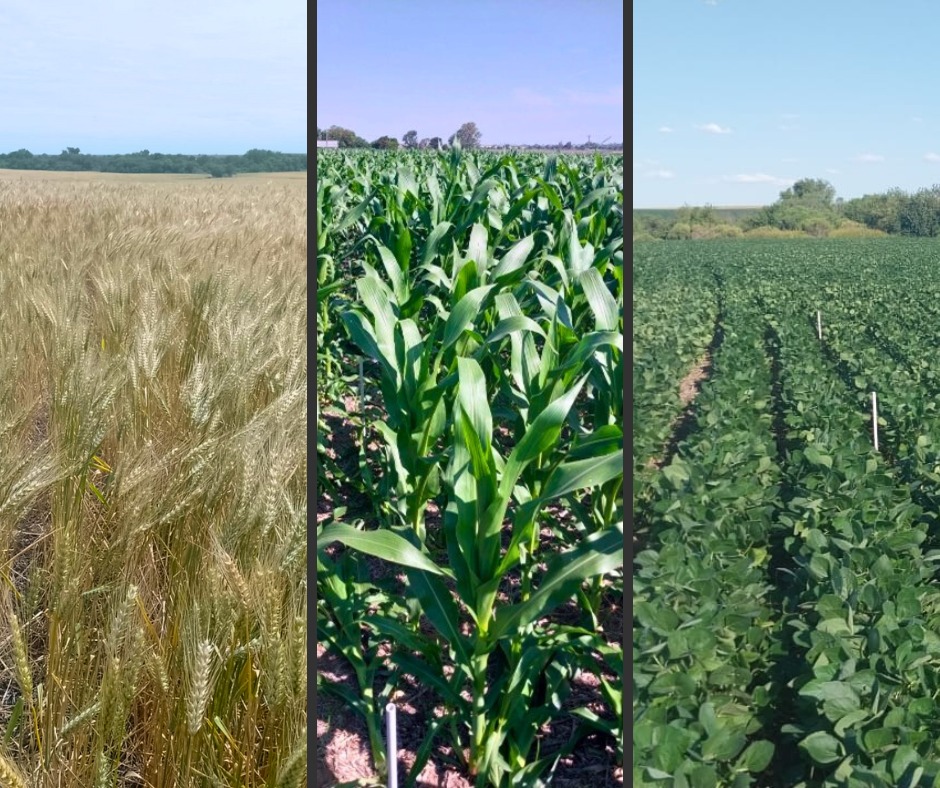
En los sistemas productivos, los cultivos están sometidos a situaciones desfavorables. Los bioestimulantes de las plantas (BP) son productos que buscan adaptar el cultivo al ambiente, mejorando su crecimiento, la respuesta al estrés y/o la calidad de los cultivos. Gran parte de la bibliografía informa incrementos entre el 15% y el 20% del rendimiento. El objetivo de este trabajo fue dimensionar la respuesta de los BP en la región de Entre Ríos, a partir de ensayos en los cultivos de trigo (41 ensayos), soja (37 ensayos) y maíz (16 ensayos) en diferentes campañas. Para el conjunto de los datos, se determinó que en los cultivos de soja y trigo los rendimientos se incrementaron significativamente con el agregado de BP: 5% y 3,4%, respectivamente. El incremento y la eficacia agronómica fue mayor en ambientes más desfavorables, donde un solo momento de aplicación durante el ciclo fue más eficiente que aplicaciones múltiples. Para el maíz no hubo ventajas con el uso de estos insumos.
Descargas
Detalles del artículo

Esta obra está bajo una licencia internacional Creative Commons Atribución-NoComercial-CompartirIgual 4.0.
Los autores conservan los derechos de autor y garantizan a la revista el derecho de primera publicación del trabajo bajo una licencia Creative Commons (BY-NC-SA) que permite a otros compartir con un reconocimiento de la autoría y de la publicación inicial en esta revista.
Los autores están autorizados a realizar contratos adicionales por separado para la distribución no exclusiva de la versión de la obra publicada en esta revista.
Se permite a los autores difundir sus trabajos electrónicamente.
Citas
AMADOR H, IZQUIERDO F Y VÁZQUEZ PADRÓN V. 2018. Revisión bibliográfica las sustancias húmicas como bioestimulantes de plantas bajo condiciones de estrés ambiental. Cultivos Tropicales, 2018, vol. 39, no. 4, pp. 102-109. ISSN digital: 1819-4087.
ANDERSON W.; R. SEAGER; W. BAETHGEN AND M. CANE. 2017. Crop production variability in North and South America forced by life cycles of the El Niño Southern Oscillation. Agricultural and Forest Meteorology. Volume 239, 2017. Pages 151-165. ISSN 0168-1923. https://doi.org/10.1016/j.agrformet.2017.03.008.
ANDERSON W.; R. SEAGER; W. BAETHGEN AND M. CANE. 2018. Trans-Pacific ENSO teleconnections pose a correlated risk to agriculture. Agricultural and Forest Meteorology. Volume 262, 2018, Pages 298-309. ISSN 0168-1923. https://doi.org/10.1016/j.agrformet.2018.07.023.
AYOUB, I; E. D. BIGATTON; A. BALLATORE; N. GASTALDI; A. BERDINI. 2022. Evaluación del efecto bioestimulante de Bacillus spp como rizobacteria promotora del crecimiento vegetal sobre el cultivo de maíz (Zea mays l.); Universidad Nacional de Córdoba. Facultad de Ciencias Agropecuarias; Nexo Agropecuario; 10; 1; 8-2022; 1-6
BEHIE, S.W., BIDOCHKA, M.J. 2014. Nutrient transfer in plant-fungal symbioses.Trends Plant Sci. 19, 734–740.
BER G. 2009. Plant–microbe interactions promoting plant growth and health: perspectives for controlled use of microorganisms in agriculture. Appl Microbial Biotechnology 84, 11–18 (2009). https://doi.org/10.1007/s00253-009-2092-7
BOUTAHIRI S., R. BENRKIA, B. TEMBENI, O. IDOWU, O. OLATUNJI. 2024. Effect of biostimulants on the chemical profile of food crops under normal and abiotic stress conditions, Current Plant Biology, Volume 40, 2024, 100410, ISSN 2214-6628, https://doi.org/10.1016/j.cpb.2024.100410.
CALVO P.; L. NELSON & J.KLOEPPER. 2014. Agricultural uses of plant biostimulants. Plant Soil (2014) 383:3–4. DOI 10.1007/s11104-014-2131-8
CARMONA M. Y F. SAUTUA. 2011. Impacto de la nutrición y de fosfitos en el manejo de las enfermedades en cultivos extensivos de la región pampeana. Actas Simposio Fertilizar 2011. Ed IPNI (Instituto Internacional de Nutrición Vegetal) y Fertilizar 73-82 pp. 18 y 19 de mayo, Rosario, Argentina.
COHEN, J. 1988. Statistical power analysis for the behavioral sciences (2nd ed.). Hillsdale, NJ: Lawrence Earlbaum Associates.
CRAIGIE, J.S. 2011. Seaweed extract stimuli in plant science and agriculture. J. Appl.Phycol. 23, 371–393.
D’ANDREA K, HISSE I., GALIZIA L., OTEGUI M. 2023. Cap. 16: Efectos del mejoramiento genético sobre el rendimiento y sus determinantes. En Ecofisiología y manejo del cultivo de maíz. 1a ed. - Balcarce: Fernando Héctor Andrade, 2023. ISBN 978-987-88-8326-7
DI RIENZO J.A., CASANOVES F., BALZARINI M.G., GONZALEZ L., TABLADA M., ROBLEDO C.W. 2020. InfoStat versión 2020. Centro de Transferencia InfoStat, FCA, Universidad Nacional de Córdoba, Argentina. URL http://www.infostat.com.ar
DU JARDIN, P. 2012. The Science of Plants Biostimulants: A Bibliographic Analysis. Contract 30–CE0455515/00–96, Ad hoc study on Biostimulants Products. Brussels: European Commission.
DU JARDIN, P. 2015. Plant biostimulants: Definition, concept, main categories and regulation. Scientia Horticulturae 196 (2015) 3–14. http://dx.doi.org/10.1016/j.scienta.2015.09.021
DU JARDIN, P., XU, L., AND GEELEN, D. 2020. “Agricultural functions and action mechanisms of plant biostimulants (PBs),” in The Chemical Biology of Plant Biostimulants, eds D. Geelen and L. Xu (Hoboken, NJ: Wiley Online Books), 1–30. doi: 10.1002/9781119357254.ch1
DU JARDIN P. P. H. BROWN, T. M. DEJONG, F. CASSÁN, A. FERRANTE, V. FOTOPOULOS, G. A. MANGANARIS, P. CARILLO. 2025. Unlocking the black box of plant biostimulants. Scientia Horticulturae. Volume 350, 2025, 114281, ISSN 0304-4238, https://doi.org/10.1016/j.scienta.2025.114281
ECHEVERRÍA, H. Y H. SAINZ ROZAS. 2015. Nitrógeno. Pp. 189-228. En H. Echeverría y F. García (Eds). Fertilidad de suelos y fertilización de cultivos. Editorial INTA, Buenos Aires, Argentina.
GIANINAZZI, S., GOLLOTTE, A., BINET, M.-N., VAN TUINEN, D., REDECKER, D., WIPF, D. 2010.Agroecology: the key role of arbuscular mycorrhizas in ecosystem services.Mycorrhiza 20, 519–530.
GÓMEZ, DIANA E., REIS ERLEI M. 2011. Inductores abióticos de resistencia contra fitopatógenos. Química Viva [en linea]. 2011, 10(1), 6-17[fecha de Consulta 26 de abril de 2024]. ISSN:. Disponible en: https://www.redalyc.org/articulo.oa?id=86317320003.
IZQUIERDO, J., SCHWEMBER, A.R., ARRIAGADA, O., GARCÍA-PINTOS, G. 2023. On-farm soybean response to a field foliar applied humic biostimulant at differing cropping environments of Uruguay. Chil. J. Agric. Res. 83, 5. doi.org/10.4067/S0718-58392023000500577
IZQUIERDO, J., ARRIAGADA, O., GARCÍA-PINTOS, G., ORTIZ, R., GARCÍA-PINTOS, M., & GARCÍA-PINTOS, M. 2024. On-farm foliar application of a humic biostimulant increases the yield of rice. Agronomy J 1–13. doi.org/10.1002/agj2.21641
KOYRO, HW, AHMAD, P. Y GEISSLER, N. 2012. Respuestas al estrés abiótico en las plantas: una descripción general. Adaptaciones ambientales y tolerancia al estrés de las plantas en la era del cambio climático, 1-28.
LAURENT, A., MIGUEZ, F., KYVERYGA, P., MAKOWSKI, D., 2020. Going beyond mean effect size: presenting prediction intervals for on-farm network trial analyses. Eur. J. Agron. 120, 126127. doi.org/10.1016/j.eja.2020.126127
LI J, VAN GERREWEY T AND GEELEN D. 2022. A Meta-Analysis of Biostimulant Yield Effectiveness in Field Trials. Front. Plant Sci. 13:836702. doi: 10.3389/fpls.2022.836702
MADDONNI, G. A.; M. PARCO Y D. H. ROTILI. 2021. Manejo de la estructura del cultivo de maíz en ambientes marginales de argentina. Rev. Facultad de Agronomía UBA, 41 (2) 90-105, 2021.
MANDAL S., U. ANAND, J. LÓPEZ-BUCIO, M. KUMAR, M. KUMAR LAL, R. KUMAR TIWARI, ABHIJIT DEY. 2023. Biostimulants and environmental stress mitigation in crops: A novel and emerging approach for agricultural sustainability under climate change, Environmental Research, Volume 233, 2023, 116357, ISSN 0013-9351, https://doi.org/10.1016/j.envres.2023.116357.
NICOLÁS, C., HERMOSA, R., RUBIO, B., MUKHERJEE, P.K., MONTE, E. 2014. Trichoderma genes in plants for stress tolerance-status and prospects. Plant Sci. 228, 71–78.
OLIVARES, F.L., AGUIAR, N.O., ROSA, R.C.C., CANELLAS, L.P. 2015. Substrate biofortification in combination with foliar sprays of plant growth promoting bacteria and humic substances boosts production of organic tomatoes. Sci.Hortic. 183, 100–108.
PRADO, MRV, WEBER, OL DOS S., MORAES, MF DE, SANTOS, CLR DOS, SANTOS TUNES, M., Y RAMOS, FT. 2016. Sustancias húmicas en soja cultivada bajo estrés hídrico. Comunicaciones en Edafología y Análisis de Plantas, 47 (21), 2405–2413. https://doi.org/10.1080/00103624.2016.1243715
PRIETO, C. A.; ALVAREZ, J. W. R.; FIGUEREDO, J. C. K.; TRINIDAD, S. A. 2017. Bioestimulante, biofertilizante e inoculação de sementes nocrescimento e produtividade da soja. Revista de Agricultura Neotropical, Cassilândia-MS, v. 4, n. 2, p. 1-8, abr./jun. 2017
ROSE, M.T., PATTI, A.F., LITTLE, K.R., BROWN, A.L., JACKSON, W.R., AND CAVAGNARO, T.R. 2014. A meta-analysis and review of plant growth response to humic substances: practical implications for agriculture. Adv. Agron. 124, 37–89. doi: 10.1016/B978-0-12-800138-7. 00002-4
SCHÜTZ, L.; A. GATTINGER; M. MEIER; A. MÜLLER; T. BOLLER; P. MÄDER. 2018. Improving crop yield and nutrient use efficiency via biofertilization. A global meta-analysis. Front. Plant Sci. 8, 2204. doi: 10.3389/fpls.2017. 02204